
Muskego Past-Resident Source Eras
A backward address search crosses sources built for different purposes. Start with the modern parcel, then choose the source nearest the date under study. Use “former recorded owner” for a deed name and reserve “previous resident” for a dated source that supports occupancy.
| Source | Years or coverage | Where held | What it shows |
|---|---|---|---|
| Recorded-document images | Early 1800s to present; complete index from 1994 | Waukesha County Register of Deeds | Transfers, mortgages, plats, legal descriptions |
| Deed books | Volumes 1 through 142 | Register of Deeds | Older book and page chain |
| Maps and plats | 1859 to present | Huelsman Center and Wisconsin Historical Society | Roads, land divisions, named owners |
| County histories | 1880, 1894, 1907, 1984 | Huelsman Center | Biographical and civic references |
| Census collections | Territorial 1838 to 1846; federal through 1870; state through 1895 | Huelsman Center and genealogy services | Household and township context |
| Directories | Selected county, farm, village, and telephone years | Historical and library collections | Dated address and occupation leads |
| Obituaries and newspapers | 1859 forward, holdings vary | Historical center and libraries | Residence, relationship, and life-event clues |
Modern questions begin with the tax listing. Older Muskego previous residents may require a place name, map, and legal description before a surname search works.
Anchor a Muskego Address
Search the Waukesha County Tax Listing by address or tax key. Save the municipality, tax key, legal description, and parcel-map link. The owner attached to that parcel is a tax-record association, not automatic proof of residence.
Muskego grid prefixes are critical. If a complete street search fails, the county allows a grid-address search without the street name. Tax keys omit spaces and punctuation. The county combines local and county databases, so update timing can cause differences.
The county GIS viewer supplies map context but is informational. A survey or recorded plat controls boundaries. Once the parcel is firm, the legal description is safer than a changing road name.
Trace Waukesha Deeds Backward
The Register of Deeds Public Access portal supports instrument, book/page, subdivision, condominium, metes-and-bounds, CSM, and GIS-linked searches. Indexing is complete from January 1, 1994. Older images exist, but their name indexing varies.
- Find the current parcel, owner association, and legal description in the tax listing.
- Locate the most recent conveyance tied to that legal description.
- Read the instrument for its grantor, grantee, date, and prior-reference details.
- Search the seller as a prior grantee or follow the earlier book/page reference.
- Repeat through tract, subdivision, condominium, or office tools when the online index weakens.
- Grantor
- The party transferring an interest in the recorded instrument.
- Grantee
- The party receiving that recorded interest.
- Chain of title
- The sequence of recorded transfers affecting the property.
- Legal description
- The land description based on lot, survey, or government-survey terms rather than a street label.
Seven-digit instrument values and four-digit book/page fields may need leading zeroes. For a Certified Survey Map, start with the original legal-description index because there is no dedicated CSM index. The linked official portal is shown below.
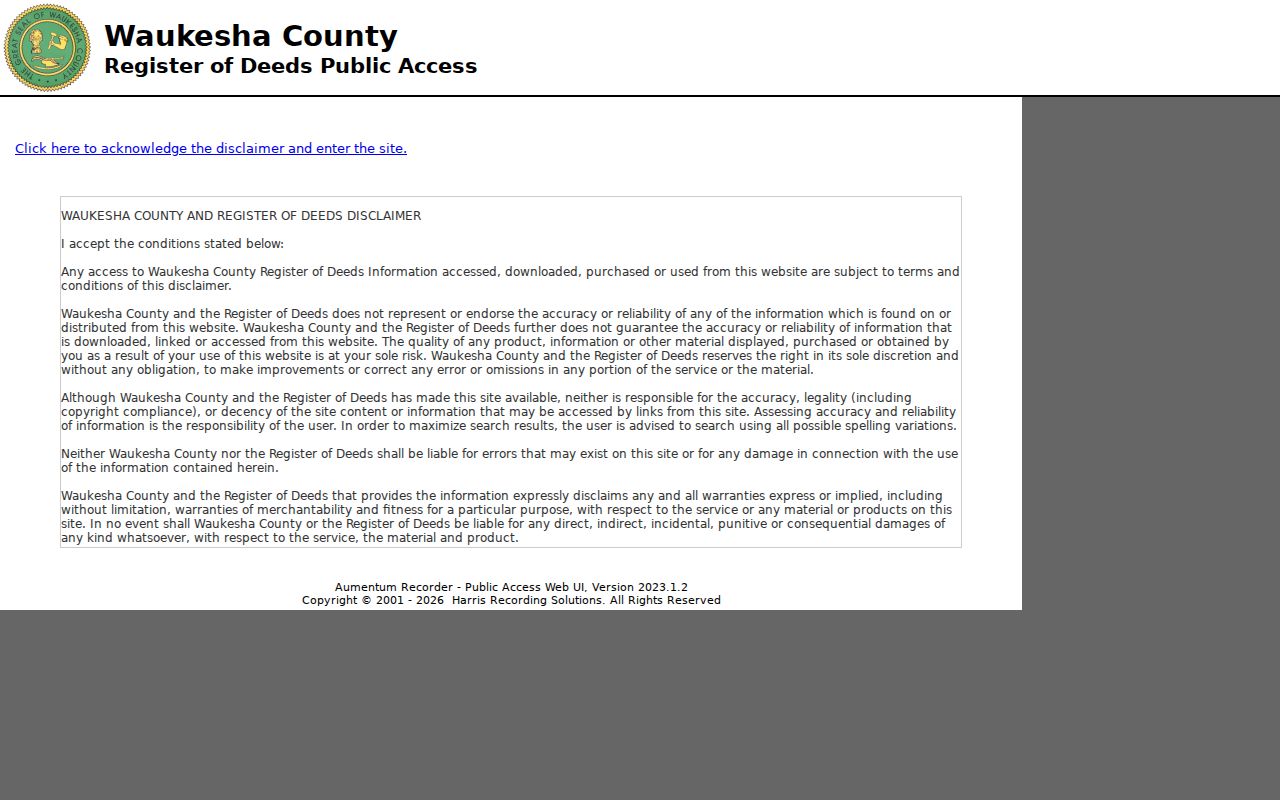
The search gateway helps locate recorded instruments, while the underlying deed and legal description supply the dated evidence for a prior owner.
Muskego Deed Access Channels
Online access is only one route. Waukesha County also provides in-person and mail access, and certified copies must come through those office channels. The Register of Deeds is at 515 W. Moreland Boulevard, Room AC110, Waukesha, with general hours from 8 a.m. to 4 p.m. on weekdays except holidays. Land-record questions go to 262-548-7589 or wclandrecords@waukeshacounty.gov.
Paper submissions made on or after May 1, 2026 need either a pre-addressed stamped envelope or an email address for return of the original. Mail returns may take 14 to 21 business days, and a submission without a return method may be rejected. This affects current paperwork, not the age or value of the historic record.
Note: The Register of Deeds preserves records and supplies copies, but does not perform a title search or resolve acreage and boundary disputes.
Rebuild Muskego Address History
Muskego became a city in 1964 and adopted its uniform grid-address system in 1982. Older sources can use township names, rural routes, lake labels, Muskego Centre, or a former road form. The 1982 date marks an official address-system milestone, not a claim that every property changed number that year.
Historic maps and plats from 1859 forward help connect the old wording to current land. The Wisconsin Historical Society describes a large map and atlas collection, but no Muskego-specific Sanborn fire-insurance sheet was verified. Do not substitute a Waukesha City sheet and label it Muskego.
A street-renaming petition requires half of the owners along the road and Common Council action. A subdivision or CSM correction also leaves a recorded affidavit trail. Those municipal and recorded records can explain why an old address disappears from a modern search.
Match Muskego Past Households
Deeds trace recorded interests, while directories and census records help test residence. A criss-cross directory arranges listings by address or phone. An alphabetical directory usually starts with a surname. Pair each dated entry with the nearest available census, map, newspaper, or obituary rather than treating one listing as a permanent household.
- Transcribe the address exactly, including grid letters, rural route, lake name, or township label.
- Locate that form on a map or plat from the same period.
- Search the nearest directory year by address and by surname.
- Compare the household with the closest available census schedule.
- Use obituaries, cemetery files, and notices to confirm relationships and dates.
The historical collection details belong on the Muskego city directories page. For this backward trail, record the directory title, year, page, printed spelling, and whether the entry appears to be residential or commercial.
Muskego Archives Fill Gaps
The Huelsman Family Research Center is the strongest local archive route. Its materials include first land ownership, abstracts, patents, mortgages, maps, census holdings, cemetery transcriptions, naturalization papers, obituaries, school files, yearbooks, and subject binders for homes, pioneers, people, and resorts. Contact the center at 262-521-2859 extension 225 or waukeshamuseum@gmail.com before a visit.
Muskego Public Library can help identify local-history files, newspapers, yearbooks, and house-history material. The Muskego Historical Society, based at Old Town Hall, adds timeline and community context. Archive material is a lead until its exact item, date, and provenance are recorded.
Naturalization papers may help with surname variants. Marriage notices and cemetery records can link relatives. Court and probate records can add dated events, but should be requested from their custodians when a complete or certified record is needed.
Resort-Era Muskego Address Clues
Muskego history contains place clues that may work better than a modern street number. Muskego Beach Amusement Park operated from 1861 to 1967, DandiLion Park from 1968 to 1977, and the interurban ran from 1904 to 1939. Resort, tavern, lake, and trolley terms can place a family or business in a dated newspaper even when a directory is missing.
A Wisconsin Historical Society property record for the former Sobek Resort on Woods Road dates the building to 1904 and cites a Muskego Public Library local-history clipping. This is a useful model: begin with a place file, follow its cited newspaper, connect the parcel through maps and deeds, and only then evaluate a person’s dated association.
Old Town Hall offers another custody clue. Meetings occurred in homes, schools, and saloons before the hall was built in 1921, and it served as interim City Hall from 1964 to 1972. Town and city-era records may therefore be dispersed among city, county, library, and society collections.
Define Muskego Previous Residents Carefully
A deed cannot establish that its grantee slept at the property. A plat may name an owner but no household. A directory may list a business, and an obituary may give only a last residence. Describe the actual evidence: “former recorded owner,” “listed at the address in a dated directory,” or “associated with the property in a historic file.”
The free Recording Notification Service can alert a current parcel holder after a new filing, but it is not retroactive, not title insurance, and not proof about past residents. A wrong tax key or incomplete legal description can miss an alert. The county cannot remove a fraudulent recording without a court order.
Lawful use. Research Muskego previous residents for genealogy, estate work, house history, and personal curiosity. Never use an old address trail to harass, track, or expose a living person.
Close the trail with a source log. Keep each record’s date, custodian, identifier, exact name and address spelling, and the narrow fact it supports. Agreement between independent records is stronger than repetition copied from one index.